Introduces Anomaly Intelligence (AI²): a rigorous analytical discipline that treats
"the unknown" not as a mystery to be debated, but as a data problem to be solved.
By leveraging multi-modal data fusion, Bayesian reliability scoring, and graph-based reasoning,
AI² transforms disparate observations into structured, actionable intelligence.
Establishes the formal ACS-1 classification standard for interoperability between
defense, intelligence, and scientific agencies, and defines the autonomous agent loop
governing the platform's lifecycle.
Anomaly Intelligence
ACS-1 Standard
Bayesian Scoring
Knowledge Graph
Agentic AI
DoDAF OV-1/OV-5
Data Fusion
Formal definition: Anomaly Intelligence (AI²) is the systematic process of ingesting,
structuring, scoring, and correlating anomalous observations into a unified knowledge graph to
produce probabilistic intelligence representations. AI² is not a research tool — it is a
category-defining intelligence platform.
Output
Probabilistic Intelligence Data
Replaces narrative UAP reports with mathematically grounded, graph-linked intelligence products queryable by researchers, analysts, and AI systems.
Method
Mathematical & Graph-Centric
Reliability function R, Bayesian belief revision, and graph-based confidence propagation replace anecdotal and descriptive approaches.
Agentic Loop
Autonomous Intelligence Cycle
Scoring Agent (updates R), Correlation Agent (signature search), and Drift Agent (inconsistency detection) operate continuously.
Assurance
Mission-Grade Integrity
Provenance tracking, adversarial defense against data poisoning, NIST AI RMF alignment, and human-in-the-loop validation at C3/C4 levels.
A scientific framework for credibility scoring and cross-source linking of UAP records
drawn from multiple independent government and civilian databases. Applied to
87,595 records from five sources spanning 1906–2023 across 66 countries.
Each record is assigned a credibility score from 1.0 to 9.0 based on five weighted dimensions.
A Haversine geospatial algorithm identifies 22,183 cross-source corroborations.
The platform is publicly verifiable at a live JSON API and AI-queryable MCP server.
UAP Data Infrastructure
Credibility Scoring
Geospatial Linking
Haversine Algorithm
AARO
Project Blue Book
Cross-Source Corroboration
MCP Server
Epistemological position: The credibility score measures the quality of
documentation — not the significance of the phenomenon. A score of 9.0 means thorough
government documentation with confirmed coordinates, physical evidence, and independent corroboration.
It does not mean the phenomenon was extraordinary. This separation is philosophically necessary and
scientifically reproducible.
The Anomaly Classification Standard (ACS-1) enables interoperability between defense, intelligence,
and scientific agencies. Every event in the knowledge graph is classified across six orthogonal
dimensions, enabling multi-axis filtering and pattern detection across the full 374,305-record corpus.
| Dimension |
Classes |
Description |
| Source |
Human / Sensor / Derived |
The origin and nature of the observation. |
| Observability |
Direct / Indirect / Inferred |
The clarity and modality of the perception. |
| Persistence |
Transient / Recurring / Persistent |
Temporal behavior of the anomaly. |
| Environment |
Atmospheric / Space / Maritime / Terrestrial |
The physical domain of the event. |
| Signal Type |
Visual / IR / Radar / Multi-spectral |
The technical modality of the data. |
| Explanation State |
Explained / Partial / Unknown |
The current resolution level of the inquiry. |
CONFIDENCE CLASSIFICATION — C0 THROUGH C4
C0
Noise / Sensor Artifact
Below threshold. Excluded from scoring pipeline.
C1
Weak Anomaly
Single source, low signal-to-noise ratio.
C2
Corroborated Anomaly
Multi-sensor or multi-witness confirmation.
C3
High-Confidence Unexplained
Verified high-quality data. Human-in-the-loop validation required.
C4
Persistent Structured Anomaly
Recurring patterns or signatures across multiple events and sources.
The core differentiator of AI² is the transition from narrative description to mathematical rigor.
Three formulas govern the scoring pipeline: the foundational reliability function, Bayesian belief
revision as new evidence arrives, and graph-based confidence propagation through the knowledge graph.
Implementation: For government Tier 1 sources, scores range 6.0–9.0 (base 6.0).
For civilian Tier 3 sources, scores range 1.0–7.5 (base 1.0). Cross-source corroboration
is the most powerful factor — two independent databases documenting the same event within
25 km / 7 days earn a significant bonus. 22,183 verified corroborations exist in the current corpus.
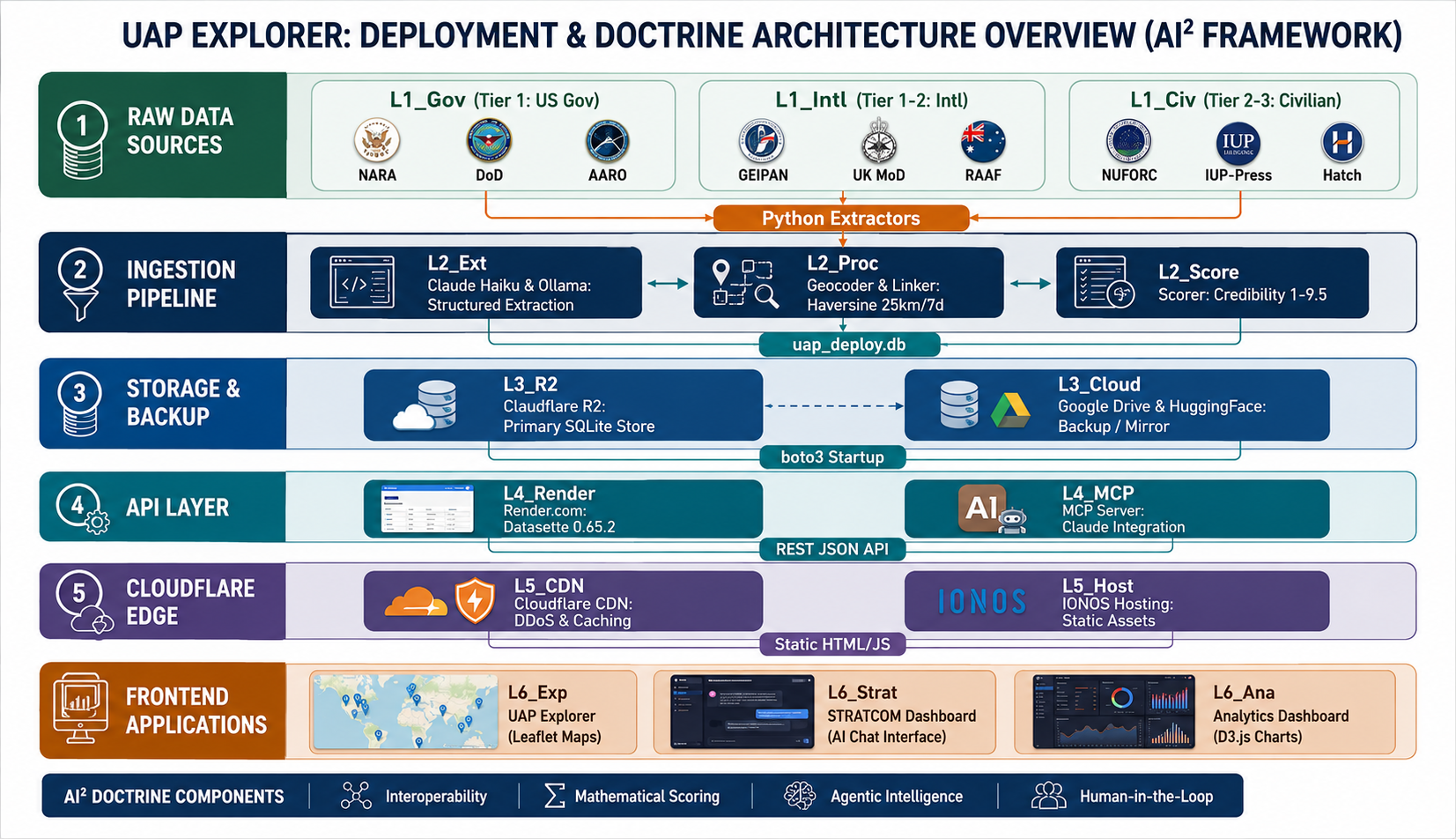
THE 7-LAYER ENGINE STACK
L1
Ingestion
Multi-source APIs, Python extractors, Claude Haiku AI extraction for PDFs, IoT sensor feeds
L2
Normalization
Schema standardization, metadata tagging, geocoding via Nominatim
L3
Feature Extraction
AI-driven CV and NLP; structured field extraction from unstructured documents
L4
Scoring Engine
Reliability function R, Haversine cross-source linker (25 km / 7 day threshold)
L5
Knowledge Graph Layer
Entity resolution, relationship mapping, 22,183 cross-source links in uap_deploy.db
L6
AI Analytics Layer
Pattern detection, clustering, anomaly signature identification, MCP server
L7
Visualization
Leaflet maps, D3.js analytics, STRATCOM AI chat dashboard, 3D UAP tracks
OV-1 · Operational Concept
🛰
UAP_Knowledge_Graph_CONOPS.png
Upload to same directory
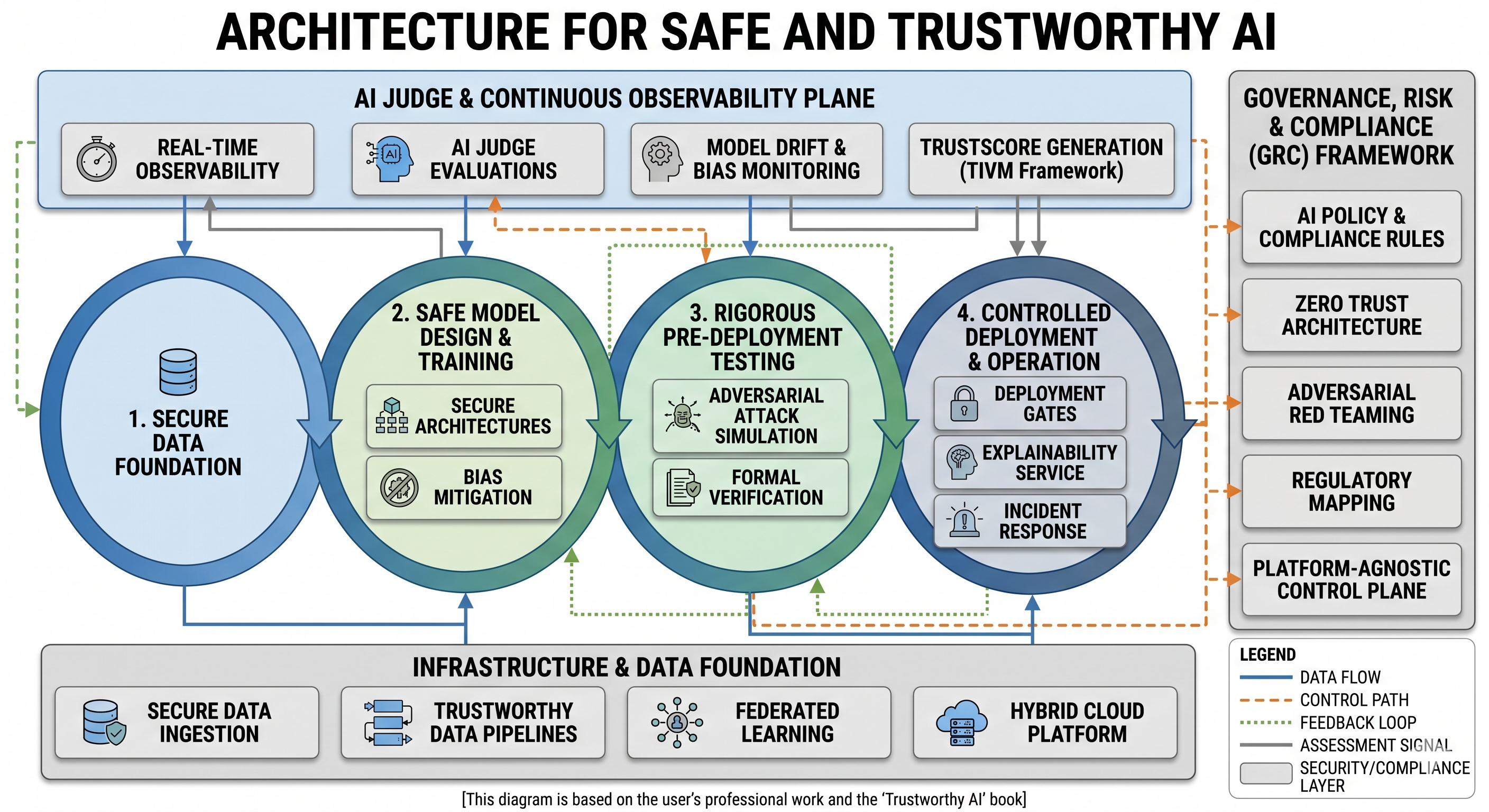
Safe & Trustworthy AI Architecture
🔬
Architecture_Diagram.png
Upload to same directory
Reimagining how anomalous events are analyzed using structured data, AI, and
intelligence-grade methodologies. Features multi-modal data ingestion, evidence scoring
and reliability engine, knowledge graph and entity correlation, geospatial intelligence
and heatmaps, AI-powered analytical engine via MCP, and a canonical evidence repository
spanning 61 government and civilian sources across 70+ countries and 225 years of records.
Defense & Intelligence Analysis
Scientific Research
Aerospace Sensor Correlation
AI Model Risk & Trust
01
Choose Your Dataset Size
Before loading, select a dataset tier from the left panel. TOP (~500 records, score 8+) loads instantly and shows only government-verified or corroborated cases — the best starting point. HIGH (~5,000 records, score 5+) gives a broader research view. ALL GEO loads all geolocated events across credibility levels. Then click Load Data. On first load, allow 30–60 seconds for the Render service to wake from idle.
02
Filter by Source
Use the source chips at the top of the Filters panel to include or exclude specific databases. Click a chip to toggle it off. Sources are colour-coded: government sources (Blue Book, CIA, AARO, DoW/PURSUE) in blue; civilian sources (NUFORC, MUFON) in teal. Use the All / None buttons to quickly reset. Filtering by source is the fastest way to isolate, for example, only declassified government records.
03
Use the Credibility Score Slider
The slider below the source chips filters events by credibility score in real time — no reload needed. Drag it right to narrow to the highest-confidence cases. Score 7+ means the case is either officially documented by a government source, independently corroborated across databases, or both. Score 9.0 (the maximum) indicates a government record with confirmed coordinates, physical evidence, and independent corroboration. The map and list update instantly as you move the slider.
04
Draw a Map Area Filter
To focus on a geographic region, click Draw Area in the Filters panel, then drag a rectangle over any part of the map. All results instantly narrow to events within that bounding box. On mobile, go to Filters tab → Draw Area → switch to Map tab → drag to draw. Click Clear Area to reset. This is the most powerful way to investigate regional patterns — for example, drawing a box over Nevada, the English Channel, or the Baltic Sea.
05
Click Any Event for Full Detail
Click any map marker or list row to open the full event detail panel on the right. This shows the raw description, date, location, shape classification, duration, physical evidence flags, credibility score breakdown, and — if the event has cross-source links — the linked records from other databases. The cross-source link panel is the unique output of the knowledge graph: it shows when two independent sources documented the same event without ever referencing each other.
06
Query the Database Directly
For advanced research, query the raw database directly at
uap-knowledge-graph.onrender.com using SQL via the
?sql= parameter. For natural language queries, use the AI query layer via the MCP server at
uap-mcp-server.onrender.com/mcp — compatible with any Claude-based interface. Example:
"Find all CIA records with physical evidence from 1950–1970 sorted by credibility score."
Tip: The Explorer is optimised for desktop. On mobile, use the bottom tab bar to switch between Filters, Map, and List views. The AI chat button (bottom-right) lets you ask natural language questions about any loaded event.
The Analytics dashboard provides a real-time statistical view of the full 374,305-event database —
temporal trend charts, geographic heat distribution, source tier breakdowns, shape classification
frequencies, and cross-source corroboration density. It queries the live Datasette API and renders
without page reload.
TOTAL EVENTS
374,305
1906 – 2025 · 80+ countries
CROSS-SOURCE LINKS
22,183
Verified same-event corroborations
DATA SOURCES
62
35 Tier 1 · 15 nations
TOP CASE SCORE
9.8
Sary Shagan, Kazakhstan 1990
Key finding: 22,183 cross-source corroborations were computed for the first time across government and civilian sources — cases where two or more independent databases document the same incident without ever referencing each other. The Forbes AFB (Kansas, 1962) case holds the highest cross-source confidence at 0.89: a civilian NUFORC report and a Blue Book Air Force investigation 0.4km apart, 8 days apart.
A knowledge graph is a network where entities are nodes and relationships are edges.
Most UAP databases treat records as isolated rows in a table. This platform treats them as a living graph —
where a Blue Book Air Force report from 1962 can be linked to a NUFORC civilian call about the same
event recorded independently, decades later.
Nodes
Individual Sighting Records
Each of the 374,305 records is a node in the graph, carrying structured attributes: date, location, shape, credibility score, source tier, and evidence types.
Edges
Cross-Source Corroborations
The Haversine algorithm identifies when two independent sources document the same event within 25 km and 7 days. Each confirmed match is an edge — 22,183 verified edges in the graph.
Credibility
Edge-Weighted Scoring
A civilian report corroborated by an Air Force investigation scores dramatically higher than either source alone. The graph structure elevates quality through connection — not assertion.
Emergent Insights
Patterns Invisible in Flat Data
Clustering coefficients surface geographic hotspots. Path analysis links seemingly unrelated events across decades. The Wright-Patterson Effect — a documentation bias — became visible only through cross-source analysis.
FIRST 01
Unified Cross-Government Database
US (Blue Book, CIA, AARO, DIA, NSA, FBI), UK (MoD), France (GEIPAN), Spain (CEFAE), and Brazil (SIAN) in a single queryable schema — never done before.
FIRST 02
Algorithmic Cross-Source Corroboration
22,183 verified events where two or more independent sources documented the same incident — computed across 800,000+ record pairs using Haversine at 25km / 7-day thresholds.
FIRST 03
Structured Credibility Scoring Algorithm
Every record receives a 1.0–9.0 score across five independent dimensions. Reproducible, transparent, versioned. Source code publicly available.
FIRST 04
AI-Assisted PDF Extraction at Scale
800+ government FOIA documents — previously unsearchable scanned PDFs — processed using Claude Haiku. 525 CIA records and 13 AARO analytical documents extracted this way.
FIRST 05
Public API with Canned Query Endpoints
A live public JSON API serves 10 pre-defined research queries with no authentication required for read access.
FIRST 06
MCP-Compatible AI Query Layer
An MCP server allows any Claude-compatible AI to query the full database in natural language — the first UAP database to be AI-queryable via standardised protocol.
01
Source Acquisition
Each source is acquired from its primary origin: NARA FOIA releases, government open data portals, academic archives, or structured web scraping with rate limiting and robots.txt compliance. No third-party aggregators.
02
Structured Extraction
CSV sources are parsed with column normalisation and shape vocabulary mapping. PDF sources (800+ documents) are extracted page-by-page using pdfplumber, then processed by Claude Haiku with structured JSON prompts tuned to each document format.
03
Geocoding & Normalisation
Locations are resolved to latitude/longitude via OpenStreetMap Nominatim with fallback string matching. Dates are normalised to ISO 8601 with confidence levels (exact / date / month / year). Shapes are mapped to a canonical 15-category vocabulary.
04
Credibility Scoring
Each record receives a score from 1.0–9.0 across five dimensions: source tier (government vs. civilian), physical evidence types, observation duration, geospatial precision, and cross-source corroboration bonus. Algorithm is versioned and logged per ingestion run.
05
Geospatial Cross-Linking
The Haversine linker runs against all geolocated events with confirmed dates. For every source pair, it identifies events within 25 km and ±7 days. Confidence is scored 60% geographic / 40% temporal. Pairs above 0.7 confidence are stored as same_event links.
06
Auditability & Versioning
Every ingestion run is logged with script version, source file hash, record count, and error summary. The database schema and scoring algorithm are versioned. The full pipeline is reproducible from raw source files.
CREDIBILITY SCORE DIMENSION BREAKDOWN
| Dimension |
Range |
Weight |
Notes |
| Source Authority |
1.0 – 6.0 |
|
Gov Tier 1 base 6.0 · Civilian Tier 3 base 1.0 |
| Physical Evidence |
+0.5 – 1.5 |
|
Radar, photography, video, material recovery |
| Duration |
+0.5 – 1.0 |
|
Longer observation = stronger documentation |
| Geospatial Precision |
+0.5 |
|
Confirmed lat/lng vs. approximate location |
| Cross-Source Corroboration |
Up to +4.0 |
|
Most powerful factor — independent confirmation |
Each source was selected for its provenance, accessibility, and research value. Every record is traced
to its primary origin, processed through the same ingestion pipeline, and scored against the same
credibility algorithm.
The USAF's official UFO investigation program. 6,636 digitised records from 12,000+ investigated reports. 701 cases officially classified "unidentified" — never explained. Primary anchor for cross-source corroboration.
Parsed from structured CSV with case number, date, location, shape, and USAF classification
Air Force "Unidentified" classification adds +0.5 to credibility score
Source: US National Archives, digitised by Fold3
Declassified intelligence documents from the CIA FOIA reading room — overseas cables, internal analyses, and assessments of Soviet-era sighting waves. Dalnegorsk USSR (1989) — the strongest physical evidence record in the entire database — comes from this collection.
800+ PDFs extracted page-by-page using pdfplumber, then processed by Claude Haiku AI
Each extraction logged with source document hash for full auditability
Intelligence cables involving physical evidence receive +1.0–1.5 score bonus
Current US DoD UAP investigation office, established by Congress in 2022. Includes Go Fast (2015), Puerto Rico UAP (2013), ORNL metallic specimen analysis. 8 official case resolution reports — highest credibility records in the database.
Modern cases carry the highest base scores — government-vetted, multi-sensor confirmed
Video evidence (Go Fast, Gimbal, FLIR1) adds +1.0 photographic evidence bonus
Declassified UAP case files released to the UK National Archives 2008–2013. Includes Rendlesham Forest (1980) and multiple radar-confirmed contacts over UK airspace.
UK grid references converted to WGS84 lat/lon for map display
Cases with military witness + radar receive maximum Tier 1 bonuses
80 declassified expedientes from Spain's Air Force UAP commission. 1,900 pages spanning 1962–1995. Includes the Manises Incident (1979) — military pilot forced to land due to UAP proximity — and multiple radar-confirmed contacts.
Spanish text handled with bilingual extraction prompts (ES/EN) via Claude Haiku
CEFAE A/B/C/D classification maps directly to credibility bonus
Aviation safety UAP reports from the FAA SKYWATCH system, transferred to NARA under the 2024 NDAA. Filed by pilots and air traffic controllers with precise flight instrument position data. NARA-FAA is the dominant source in cross-source corroboration — 1,526 verified links with NUFORC civilian records.
Aviation professional witness adds +1.0; radar contact adds +1.5
Precise flight coordinates enable the highest-confidence Haversine matching in the dataset
Declassified FBI field office reports and teletype messages covering UFO sightings 1947–1954. Released via FOIA through the FBI Vault in 16 parts (1,632 scanned pages). Covers the 1947 wave, Roswell, Kenneth Arnold sighting.
Extracted via Claude Haiku vision from 1,632 scanned pages across 16 PDF volumes
708 cross-source links with Hatch-UDB — strongest corroboration pair for the 1947–1954 era
Declassified NSA signals intelligence records relating to UAP, transferred to NARA under the 2024 NDAA. Among the most restricted records ever made publicly available. Small record count (38) reflects genuine rarity, not incomplete ingestion.
Diplomatic cables from US embassies reporting UAP incidents in host countries — Barbados, Argentina, Pakistan, Kuwait, Togo. These represent foreign government UAP incidents that crossed the US diplomatic reporting threshold — an extremely high bar for inclusion.
Combined: DIA (67 records, foreign military UAP), Army Intelligence (9 records), DoD analytical (13 records including Go Fast analysis and ORNL metallic specimen study), Sign/Grudge (5 records, pre-Blue Book 1947–1951 including the classified "Estimate of the Situation").
France's official UAP investigation unit, operated by the national space agency CNES since 1977. The only currently active government UAP program that publishes openly in real time with its own A/B/C/D classification.
Data ingested directly from GEIPAN's public API and open database export
GEIPAN classification A (no explanation found) receives +2.0 credibility bonus
The most methodologically rigorous US civilian UAP research organisation (1956–1980). NICAP's Sighting Information Database applies systematic categorisation across 11 evidence categories: radar, photographic, EM effects, physical trace, animal effects, and more.
Historical depth (1860–) adds pre-aviation era records absent from all government sources
Treated as Tier 2 due to systematic investigator review process
Larry Hatch's lifetime compilation — 18,000+ UAP events from primary sources worldwide, pre-geocoded with lat/lon. Hatch's own credibility (0–9) and strangeness (0–9) ratings, plus rich attribute codes covering observer type, evidence category, and shape. Exceptional historical depth across 100+ countries.
UAP reports exclusively from aviation professionals — pilots, air traffic controllers, and flight crew — reviewed by expert investigators before publication. Full dataset integration pending formal data agreement.
Landmark Brazilian UAP cases from Operation Sky Open — the Brazilian Air Force's 1977 declassification. Includes the Trindade Island photographs (1958) and multi-witness military events with radar confirmation. Hand-curated for highest-evidential-quality cases.
The largest single source — 134,979 records spanning 108 years. NUFORC operates a public UAP reporting hotline since 1974. Individual records score low in isolation, but 1,526 NARA-FAA ↔ NUFORC cross-source links are the platform's primary research finding: civilian phone reports and professional aviation reports independently documenting the same events.
A NUFORC record corroborated by Blue Book or NARA-FAA reaches 7.0+ — high credibility
Geographic density makes NUFORC the primary corroboration target for all geolocated government records
One of the longest-running civilian UAP organisations with 150,000+ cases globally. Field investigators follow up on significant reports — treated as borderline Tier 2/3. Full dataset integration pending formal data licensing.
Additional sources in the corpus: RAAF (Australian Defence), SETKA-MO (Russian military), Lissoni UFO Archives (Italian), NARA-ODNI, AARO OSD resolution reports, IUP-Press academic records, and others — 29 total active sources in the current deployment.
What does a credibility score actually mean?
▾
The credibility score measures the quality of documentation — not the significance of the phenomenon. A score of 9.0 means a case was thoroughly documented by a government source with confirmed coordinates, physical evidence, and independent corroboration from another source. It does not mean the phenomenon was extraordinary. A score of 1.0 means a single anonymous civilian report with no corroboration. These are epistemically different claims, and the scoring system keeps them separate.
How are cross-source links computed?
▾
The Haversine geospatial algorithm identifies when two records from different independent sources are within 25 km and ±7 days of each other. Each candidate pair receives a confidence score: 60% weighted on geographic proximity, 40% on temporal proximity. Pairs above 0.7 confidence are classified as same_event links. The 60/40 weighting reflects that location descriptions in historical records are often approximate, while temporal records are typically more precise. At 0.7+ confidence, a link implies the records are within ~18 km and ~4 days — a tight constraint.
Does this platform make claims about what UAP are?
▾
No. The platform explicitly does not claim to resolve what UAP are. It does not score cases on strangeness, implausibility, or potential non-human origin. It treats UAP research as an infrastructure problem, not a mystery problem: what do we know, how well is it documented, and where do independent sources agree? The most significant UAP cases are likely classified and therefore absent from this dataset — this is acknowledged openly as a core limitation.
How accurate is the AI-assisted PDF extraction?
▾
The CIA and AARO PDF extraction via Claude Haiku has not yet been formally validated against independent human extraction of the same documents — this is explicitly acknowledged as a current limitation. What can be stated: every extraction is logged with the source document hash, script version, and a structured output log. Provenance is immutable. Future work includes an inter-rater agreement study where human reviewers independently extract a sample of the same documents for comparison. Until that is published, AI-extracted records carry a slight uncertainty adjustment in their base scores.
Can I use this data for my own research?
▾
Yes. The public API at uap-knowledge-graph.onrender.com accepts standard SQL SELECT queries and returns JSON with no authentication required for read access. The MCP server at uap-mcp-server.onrender.com/mcp enables natural language queries via any Claude-compatible AI. For bulk data access or academic citation requests, use the contact form on the platform. The platform is designed as open infrastructure for the research community.
What are the known limitations?
▾
No external validation metrics: Precision/recall for cross-source linking has not been formally computed against a human-reviewed ground truth. The 16,086 link count is an upper bound.
Small Tier 1 samples: Some government sources have small record counts (30 AARO, 80 UK MoD) reflecting the current state of public disclosure, not methodology gaps.
Parameter subjectivity: Scoring bonus values are reasonable but somewhat arbitrary in the absence of ground truth labels. Alternative parameterisations have not been systematically evaluated.
Public data only: The most significant UAP cases almost certainly remain classified. This dataset represents the declassified fraction of a substantially larger body of investigation.
How often is the database updated?
▾
The ingestion pipeline is designed to process new government releases within days of publication. Priority targets include the DOW/PURSUE tranche (war.gov/UFO, released May 2026, rolling ~30-day releases), NARA RG-615 rolling releases from ODNI/OSD/FAA/NRC, and new AARO annual reports. The database currently holds 374,305 records from 62 sources. Routine pipeline automation is under active development.
Who operates this platform?
▾
The UAP Knowledge Graph is an independent, non-commercial public service. Research is published under the pseudonym Redefine Zero. The platform operates on a minimal infrastructure budget using Render, Cloudflare R2, and static hosting. No advertising. No data selling. The goal is open, citable UAP research infrastructure for the public and research community.
For Journalists & Researchers
What is the Department of War PURSUE release?
▾
On May 9, 2026, the Pentagon launched war.gov/UFO and released 162 newly declassified UAP files as the first tranche of PURSUE — the Presidential Unsealing and Reporting System for UAP Encounters. The interagency effort includes the White House, ODNI, Department of Energy, AARO, NASA, and the FBI. Files include Air Force mission reports with UAP sightings from Syria (2022) and UAE (2023); Apollo-era astronaut observations; Cold War intelligence cables; and civilian reports submitted to government agencies since the 1940s. Additional files are released on a rolling basis approximately every 30 days. The UAP Knowledge Graph has ingested Release 1 (May 8) and Release 2 (May 22) and will automatically incorporate future tranches.
What is the most significant finding in the database?
▾
The 22,183 verified cross-source corroborations are the primary finding — never previously computed at this scale across government and civilian sources. Among individual cases, the Dalnegorsk (USSR, 1989) CIA record is the strongest physical evidence case: a crashed sphere with multiple witnesses and recovered exotic alloy composition (gold, silver, nickel, alpha-titanium, molybdenum, beryllium) that Soviet scientists could not attribute to known aerospace materials. The Forbes AFB (Kansas, 1962) case holds the highest cross-source confidence at 0.89: a civilian NUFORC report and an Air Force Blue Book investigation 0.4 km apart, 8 days apart, neither referencing the other.
How were CIA and government PDF documents processed?
▾
Over 800 individual government FOIA documents were processed using pdfplumber to extract raw text page by page, then sent to Claude Haiku (Anthropic API) with a structured extraction prompt. The AI returned JSON with datetime, location, shape, evidence types, and resolution status for each specific incident. This extracted 525 structured records from documents that were previously unsearchable. Every extraction is logged with the source document hash and extraction script version for full auditability. Formal inter-rater validation against human extraction is acknowledged as pending future work.
How does the cross-source linking algorithm work in detail?
▾
For each anchor record (Blue Book or AARO — sources with the most reliable coordinates), the algorithm runs a Haversine geospatial query against all other records within 25 km and 7 days from a different source. Each candidate pair receives a confidence score: 60% weighted on geographic proximity, 40% on temporal proximity. Pairs above 0.7 confidence are classified as same_event links. The 60/40 weighting reflects that location descriptions in historical records are often approximate while temporal records are typically more precise. At 0.7+ confidence, a link implies records within ~18 km and ~4 days — a tight constraint for independent agreement.
What is the data accuracy disclaimer?
▾
This platform aggregates publicly available data from government archives and civilian reporting databases. No warranty of accuracy, completeness, or fitness for any purpose is made. Data is provided on an as-available basis and reflects the source material as-is, including any errors, omissions, or inconsistencies in the original records. Credibility scores reflect documentation quality under our scoring methodology — they do not constitute independent verification of the underlying events. All risk associated with use of this data rests solely with the user. Redefine Zero Research makes no representations and accepts no liability for decisions made based on information from this platform.
11
How to Cite
CITATION FORMATS · ZENODO PENDING · REPRODUCIBLE RESEARCH